Monday, February 05, 2007

Still living

It's amazing that anyone is still visiting this blog, considering how infrequently I've been updating it in recent months, but I'm still getting about a half dozen visitors a day. I think they arrive here by accident. But all is well in my world - here's a quick update:

  • I've now landed myself a permanent job,
    which is great because it brings me and Emily the security we need. One slight drawback is that I'm now doing a significant amount of commuting and have little time for blogging. I'm also using it as an opportunity to overcome my fear of public speaking.
  • Emily and I are now engaged !
    It should be interesting - a Humanist ceremony with a reading by a Zen nun and my brother's wife and daughters in their hijabs. Shall I wear my kilt?
  • Emily and I are planning to get a dog !
    A small one - either that or a rat...
  • The home improvements continue their steady plodding
    How long will it take?
  • I'm making good progress with my rakusu
    I was hoping to get Bodhisattva Ordination (a terribly grand name given in our organisation for 'taking the precepts') at Summer Sesshin this year, but it looks like this might be postponed again. We'd like to have a child within a couple of years so this might be the last chance we get for an exotic holiday in the Far East for a long time. After that there won't be any holiday time left for the 9 day retreat needed for ordination. It will just have to wait - my committment is in my heart. Maybe I'll start a kesa.
  • I just came back from another 3 day sesshin in Wales.
    Really enjoyed it. More responsibility this time - I was 'Service' outside the Dojo and 'Pillar' inside. Guy is a great teacher. I asked him a question:
    What is the difference between practicing Zen and practicing Zen as a Buddhist?
    His answer was that not only can Zen not be separated from Buddhism, but that all religion and all life was essentially Buddhism whether it goes by that name or not. I liked these lines he came up with:

    At the bottom of the ocean there are no waves
    There is only peace and unity

  • My understanding of Buddhism is less abstract and intellectual now and more real
    Don't have too much time for or interest in online debates of any sort.

Saturday, December 02, 2006

Fear and Zazen in Norfolk

Last weekend I attended my second proper sesshin - two and a half days of zazen, Buddhist teachings and ceremony, work, silence and socialising. I enjoyed it tremendously of course.

I'm not the most sociable of people - I like to have my own personal space and time, which was a slight issue for me - but they were a great crowd of people, and the atmosphere was great and I made a few new friends.

I found the extended periods of zazen easier than last time. My posture is better - I didn't get the tense painful shoulders this time and I've almost got my sit-in-lotus-without-leg-going-completely-numb technique perfected. Also I have a greater acceptance now of discomfort which makes it easier to tolerate. And although my mind still wanders a lot, I think my Zazen was deeper - I certainly noticed a difference to my sitting when I came out, which was considerably deeper.

The Gudo, Jean Pierre, (who I just found out has a physics PhD) is perhaps slightly less approachable than Guy (the Gudo at my last sesshin), but I really enjoyed his teaching style. He's clearly a very intelligent man with a profound understanding of Buddhism. He put a new and refreshing emphasis on appreciation and expression of gratitude (even if we know not who or what to be grateful to), getting away from the tendency to interpret Zen as a sort of nihilism or amoralism, which is prevalent is a great deal of western thinking about Zen. There are two sides of the coin and the True Way is a path taken between them.

There was one incident, however, which I found really hard. I had a question I wanted to ask during the mondo (formally and publically asking the Gudo questions). I kept turning the question over in my mind, imagining the amusing way in which I was going to deliver it. However, although I got up and asked Guy a question last time, for some reason this time I couldn't summon the nerve. I've done the highest bungee jump in the world without hesitation (twice) and I've been cage diving with great white sharks, but public speaking still terrifies the wits out of me. (On the way home Gaby told me that there's a book on overcoming fear of public speaking called 'And Death came Third' - because public speaking comes top of people's fears and death comes third , don't know what comes second)

So after the mondo I asked the Secretary if it was possible to speak to the Gudo more privately at some point. Immediately I was suprised to be hurried into the room where he was sitting closely with what I can only describe as his 'Inner Circle' all of whom of course went silent and I was asked to divulge my question.

My mind went completely blank.

The question had gone. I was aware only of massive amounts of adrenaline rushing around in my brain and my consciousness of the attention of the people in the room. It was my first proper meeting with Jean Pierre and while at some level I had probably hoped to impress him and the senior practitioners around him with my understanding of Buddhism, instead I was exposing myself as being about as 'un-zen' as it is possible to be. There go my fantasies about reacting spontaneously and unselfconsciously to a roshi's koan. I made self-depreciating remarks to hide my embarrassment and buy some time, but there it was - I had intruded on the Gudo outside of the mondo with my little question and now I couldn't remember it and I was standing there like an idiot, watched by all the most important people at the sesshin. I was mortified with embarrassment. A timely reminder of suffering in the midst of my cosy zen thoughts perhaps. It felt like I was there for about a minute trying to remember the question but it was probably half that. Anyway after a bit of prompting I remembered my question: 'You were talking about the Buddhist teaching that 'Nothing is hidden'. Can you explain further what it means?' He explained it in terms of the famous Butterfly Effect - of effects resonating across the universe. It didn't mean that at any point in space and time we had access to all information. Ah it means that nothing is cut-off or separate, I thought. I stood and gassho'ed to the Gudo with a smile saying 'Thank you very much'. He asked for my name, and I actually felt a secret reluctance when I gave it to him, as if at some level I hoped instead that he and everyone else in the room would forget all about it and forget all about me and I could leave the room and it would be as if it had never happened.

I sat with these feelings through an hour and a half of Zazen. After that I needed to speak to Rosemary who was playing the role of Agony Nun for the weekend, and fortunately just after that we all had a few drinks to celebrate the last night of the sesshin. That helped too. I came to thank Jean Pierre when it was time to leave and he told me to keep up the brave face - and he shook my hand and told me that a question about Buddhist philosophy was like a gift to him. Very gracious.

It was a good lesson, all round.

Thursday, November 16, 2006

Zen nonsense

It is a commonplace explanation of Zen Koans that they are riddles with no logical solution, designed to provoke a non-rational response. While this is not absolutely wrong, it is generally misunderstood to mean that the responses to Koans are arbitrary nonsense. Ben-ami Scharfstein makes a direct equivalence between Zen and Dada in The Sound of One Hand.

Dadaists used absurdity as a tool to articulate despair. Dada art was created with junk and visually repulsive materials as an expression of their stringent anti-establishmentarianism. Ben-ami Scharfstein equates this nonsensical Dada trait with the 'mystical madness' of Zen masters in his introduction to The Sound of the One Hand. He cites a poem by one of the Dadaists, Kurt Schwitters that begins with:

Z
A R P
A B C

and ends with :
Z
Z
Z

This nonsense verse is compared to one composed by Master Mumon who attained satori after a four-year contemplation of the 'Mu koan':
Mu! Mu! Mu! Mu!
Mu! Mu! Mu! Mu!
Source: http://www.lifepositive.com/Spirit/world-religions/buddhism/zen/koan.asp

This is of course quite inaccurate, but an understandable mistake to make. Zen koans are often composed of complex metaphors and are often genuinely paradoxical, so to those unfamiliar with them they might well seem indistinguishable from Dadaist nonsense. Compare this:
"The blue mountains are constantly walking. The stone woman gives birth to a child in the night...the East Mountain is moving over the water"

With:
"DADA doubts everything. Dada is an armadillo. Everything is Dada, too. Beware of Dada. Anti-dadaism is a disease: selfkleptomania, man's normal condition, is DADA. But the real dadas are against DADA."

Or for that matter:
"But four young oysters hurried up,
All eager for the treat:
Their coats were brushed, their faces washed,
Their shoes were clean and neat --
And this was odd, because, you know,
They hadn't any feet."

I've come across Zen Buddhists online who have literally Edward Lear verses in response to questions about Buddhism. But this is a misunderstanding of Zen. Just because you can't immediately make sense of something does not mean it is nonsense.. All the koans I've been able to investigate in detail can be understood in terms of Buddhist philosophy, although it is of course possible that there are others which are indeed arbitrary nonsense - there are plenty of koans I can't yet make sense of.

It is a little known fact that the Dada art movement which later evolved into the Surrealist movement was strongly influenced by Zen, or perhaps more accurately, by a misinterpretation of Zen as anti-rationalism. This is not to say that Zen and Dada have no relation or that Dada has no value. Dada was a highly radical, subversive, nihilistic, anti-art movement, which sought to destroy traditional culture and aesthetics - to overthrow order and the violence - in particular the First World War - which the Dadaists believed it caused.

Dada is anti-rational - it aims to make as little sense as possible, to be free from reason. The aim of Zen is freedom too, but it is freedom from rejection as well as attachment. It is neither nihilistic nor chaotic. The key difference between Zen and Dada is that Dada is a form of nihilism and anti-rationalism and Zen avoids such extreme views, being a direct engagement with reality rather than being a philosophy or ideology at all.

You will never understand that life is a pun, for you will never be alone enough to reject hatred, judgments, all these things that require such an effort, in favor of a calm level state of mind that makes everything equal and without importance. Dada is not at all modern. It is more in the nature of a return to an almost Buddhist religion of indifference.
Tristan Tzara, Dada Manifesto 1918

http://en.wikipedia.org/wiki/Dada
http://www.angelfire.com/zine/dadamonster/tzara.html
http://www.english.upenn.edu/~jenglish/English104/tzara.html

A monk was asked to discard everything. "But I have nothing," he exclaimed. "Discard that too!" ordered his master.
(An aim of Buddhism is to avoid clinging to all concepts. 'Nothing' is a concept and is clinging to it can be a real problem for practioners. The master is telling the student to discard this too.)

Q: What is Buddha ? A: Dried shit on a stick.
(I think this is an attempt to sabotage the questioner's dualistic thinking, his mental searching for 'Buddha' separate from the mundane, a sacred reality separate from the profane. Buddha is this very reality, even on a stick you wipe shit with. So the master is switching the student's concept of the sacred with his concept of the profane in order that he can realise the sacred in the profane and the profane in the sacred, in other words to see the interdependent whole. This is the same as the principle: 'There is no difference between samsara and Nirvana')

I read a description of 'enlightenment' in terms of mountains walking a while back and it seemed like nonsense, but I came across an interpretation of it again recently. It was this that prompted this posting.

"The blue mountains are constantly walking. The stone woman gives birth to a child in the night...the East Mountain is moving over the water"

My understanding is that these words are indended to challenge the ordinary view of a strict difference between living and non-living things - even mountains which appear to have persisted for eternity have no fixed nature and are in a state of continuous dynamic change, with mountains flowing through the landscape, being 'born' and 'dying' and flowing (as islands) across water.

Sunday, November 05, 2006

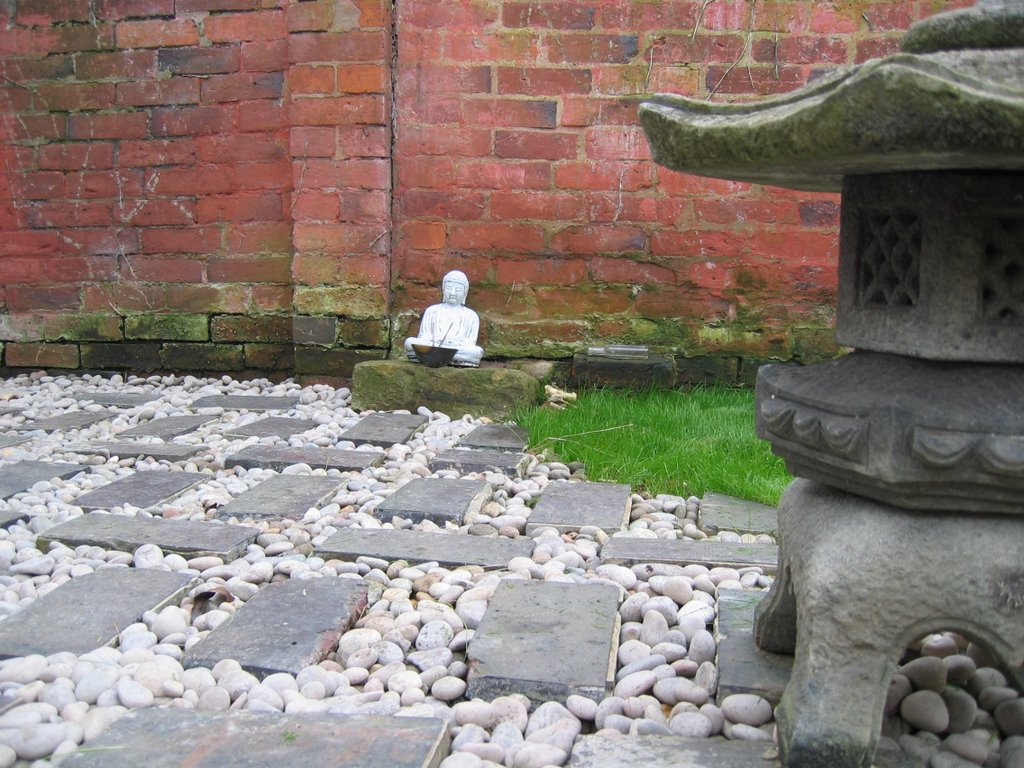
My Japanese Garden #2


I've now more-or less completed one end of the garden - don't forget that this entire section of the garden was covered in about 6 inches of concrete when I moved in. The main jobs remaining are to sort out the fencing, place some boulders and planting some cherry trees and other plants. It's taking a long time - I don't have a lot of time to spend on it - hopefully this time next year it will be near completion.


Sunday, October 22, 2006

The Buddha Manager

I´m on holiday in Seville at the moment with my son, my girlfriend Emily, her brother Guy and his daughter. Right now I´m waiting to be moved to a new room. There have been a lot of cock-ups in the hostel we´re staying at. It´s a friendly, lively atmosphere here, but really chaotic. Every night there have been people sleeping in the common room. Last night when we got in I found that I could´nt open my safe. Then around 2 or 3am I got woken by an American girl who my bed had been let to by mistake. It is mostly resolved now but I´m waiting in for them to move us to a new room.

I overheard a conversation on the first day between the manager and some Taiwanese girls. They expressed a little surprised that he was the manager - he´s very casual. And, showing his wide cultural knowledge, he explained that he was a buddha manager. I didn´t hear their reply. I can think of more accurate adjectives to describe his management style. But it´s interesting that the word ´Buddha´ is seemingly seen as interchangeable with ´incompetent stoner´.

We´re having a really nice time here. It´s great how the Spanish have a family- and child-friendly night-life culture unlike the UK where night-life seems only to cater mainly for the young and single. This approach seems healthier and there was this interesting news story which ties in with this


Also I´m getting through quite a lot of the Shobogenzo.

Saturday, September 16, 2006

Banksy


The 'guerrilla artist' Banksy who recently attracted publicity for placing a life-sized model of a Guantanamo Bay detainee in Disneyland and for defacing Paris Hilton CDs has launched an exhibition in LA featuring a pink elephant in a pink 'room'. I think the elephant in the room is supposed to represent undiscussed world issues.

I'm really enjoying his work and his attitude. Some of it is reminiscent of Dead Kennedys and Radiohead artwork - in style and social theme. Great!

'Guerrilla artist' Banksy hits LA

In pictures: Banksy in LA

Monday, September 11, 2006

Karma Police


I recently had a bit of a run-in with the administration of a large Buddhist internet forum. The administration had recently changed and the new powers were taking a dim view of the free-form expression and allegedly almost 'anything goes' attitude of many of the posters on the Zen forum and were taking steps to purge this element. References to burning Buddha statues, killing the Buddha or questioning the authority of the mainstream interpretation of Buddha's teachings were to be forbidden.

Now, I've never been much into posting pictures of flowers or *gasp* pop lyrics on that forum. Most of my involvement was relatively serious discussion. Nor have I seriously challenged the accepted view of the content of what Buddha taught. However, I freely express my own agnosticism or doubt about unknown metaphysical truths such as the traditional descriptions of karma and rebirth.

Because of not accepting this, I thought I would have to always remain on the periphery of Buddhism. Yet it is clear that the Soto Zen sect I belong to does not insist on such beliefs. It appears that Brad Warner's branch of Zen does not insist on such acceptance or belief either since when I asked Gudo Nishijima directly about the afterlife he replied essentially that when we die 'that's it'. This as far as I understand could actually be classed as the view of Annihilationism - definitely regarded by Buddha as a 'wrong view' but this is another story and perhaps I misunderstood him.

Even though these administrators were not Zen practitioners they took the view that 'Zen Buddhists are Buddhists first' - in the sense that Zen Buddhists too had to accept 'Right Understanding' and that Right Understanding included acceptance of karma and rebirth.

My take was that a Zen practitioner does not cling to beliefs one way or the other. That moment-to-moment rebirth renders life-after-death meaningless and that belief that 'we' will be reborn ('sans self' or not) may be a form of covert Eternalism. But it was made clear to me that my views were not welcome anywhere on the board, so I have voluntarily avoided the place since.

Thursday, September 07, 2006

Radiohead: V Festival 2006


What can I say? They did a huge set with loads of stuff from OK Computer and The Bends. They played Creep. Wow...

Beauty tips

People who meet me generally think I'm about 30 or in my early 30s, yet I'm at the venerable age of 37 years old! One colleague even thought I was 25! So, although no one ever asks me how I stay so young-looking I'm going to do the right thing and tell you anyway:

  1. Eat healthily
  2. Don't get too stressed about not doing enough exercise
  3. Avoid excessive sunlight.
    Why not try staying indoors and sitting in front of a computer instead?
  4. MAINTAIN A NEUTRAL FACIAL EXPRESSION AT ALL TIMES

Friday, August 04, 2006

Zen and therapy

Godo Guy Mercier talked of zazen at times in terms similar to a self-help therapy with destructive emotional and mental habits resolved through careful observation over a long period of time. Not radically dissimilar to Cognitive Behavioural Therapy I suppose.

In a recent podcast I was listening to, Cho Bo Ji was similarly describing Zen, free from mythology and in terms of acceptance of reality and avoiding getting 'mentally stuck'.

Stephen Batchelor describes Buddhism in secular terms, stripped of religious beliefs, leaving just a path to a positive way of being.

All of this makes a lot of sense to me. Yet there was quite a strong backlash against Batchelor from the Buddhist community, who apparently rejected his agnosticism about rebirth and karma, apparently seeing Batchelor's version of Buddhism as a pale, secular shadow of their noble religion, with it's talk of other worlds, heavenly realms and cycles of birth and death.

So, were they right or can Buddhism be described in terms of psychotherapy?

While it's natural for people to hold onto religious beliefs and be attached to myths about creation, life after death and so on, however I never really saw such beliefs as the essence of Buddhism. Buddha tended to refuse to answer metaphysical questions either on the basis that they are irrelevant to finding an escape from suffering or that the questions themselves were misconceived. Certainly I don't see Buddhism as intended as a belief system. It's for these reasons that I practice Zen rather than one of the schools of Buddhism, which are heavier on metaphysical or supernatural belief.

There are a number of therapists who have made similar claims (references needed), regarding Buddhism as an example of self-realisation which goes beyond ordinary therapy. There are countless therapists who incorporate Buddhist techniques and countless Buddhist books sold as theraputic self-help books.

One difference is that therapy is seen as a cure for the abnormal psychology of the section of society which is regarded as pathological, in other words, 'sick'. Buddhism on the other hand is seen as a universally appropriate practice. It is for this reason, that practicing Buddhism may been seen as having less of a social stigma than receiving therapy. To be precise, this is not because Buddhism does not pathologise one section of society, but because Buddhism regards virtually every sentient being as 'sick' in a sense. Only arahants and/or buddhas are free from this 'disease' that is existence. I think the key difference here is that our attitude towards mental health tends to be normative, that is, the goal of therapy is to make the abnormal normal. Buddhism on the other hand points out that normal people are in a state of suffering too and proposes that it is possible to be better than just 'normal'.

Far from being shameful, to practice Buddhism is regarded in Buddhist societies as a noble pursuit. Wouldn't this attitude of respect for one who has taken responsibility for his or her own welfare be more conducive to mental health and to people's preparedness to deal with these problems, than the current dominant one of castigating those who take such steps as 'the sick' and 'abnormal'? Perhaps it relates to a western attitude of scorn towards those who seek to find happiness in favour of those who are stoically productive?

So perhaps both Buddhism and therapy can be seen as not fundamentally different, just with different cultural meaning and with goals set at different points. But, if this is the case, what about Buddhist philosophy and Buddhist insights? Well, in Buddhism, thoughts are inseparable from the thinker - philosophy is just the mental acts of a particular being at a particular time - there are no Platonic thought-forms existing in some transcendent abstract plane.

One of the most brilliant and influential philosophers of the 20th century, Ludwig Wittgenstein, saw metaphysical philosophy as a sort of sickness - an overextension of linguistic terms beyond their valid scope, attempting to speak about that which is ineffable. There is a lot of overlap between this an Zen. In Buddhist terminology this might be described as a confusion between conventional and ultimate truths. Wittgenstein's cure was Linguistic Philosophy - language is based on convention and needs to be reigned in when it is applied as if universally applicable.

Our grandest philosophies and most penetrating insights are still just thoughts. Our insights are just the dropping away of our delusions and in that sense are dependent upon them. This is one reason not to get attached to any insights we have. Even if we become 'fully enlightened', we are still entirely human.