Sunday, February 05, 2006

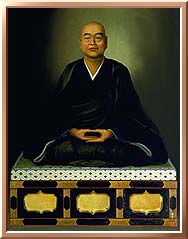
Dogen's Genjo Koan (Pt.2)

I'm now going to make a direct comparison between analyses of the Genjo Koan published by Thomas Cleary and Gudo Nishijima. For the purpose of comparison I have used the same system of section numbering (in square brackets) that Nishijima uses in his article.

[83] Text:

As all things are buddha-dharma, there is delusion and realization, practice, and birth and death, and there are buddhas and sentient beings. As the myriad things are without an abiding self, there is no delusion, no realization, no buddha, no sentient being, no birth and death. The buddha way is, basically, leaping clear of the many of the one; thus there are birth and death, delusion and realization, sentient beings and buddhas. Yet in attachment blossoms fall, and in aversion weeds spread.


Nishijima comments:

This paragraph is composed of four sentences. The first is: “When all things and phenomena exist as Buddhist teachings, then there are delusion and realization, practice and experience, life and death, buddhas and ordinary people.” What does the sentence mean? This sentence describes the situation when we think about the world on the basis of an idealistic philosophical system—a set of teachings. From this basis we can find differences between many categories; delusion and realization, practice and experience, life and death, buddhas and ordinary people. This contrasts with the second sentence which says that there are no differences if we view the world “when millions of things and phenomena are all separate from ourselves.” This second sentence tells us that if we view the world separate from our own subjective viewpoint, that is objectively, we can find no difference in value between delusion and enlightenment, buddhas and ordinary people, life and death. They are all concrete facts and have equal value as such. This is the scientific or materialistic viewpoint. Master Dogen clearly distinguishes here between the philosophical standpoints of the idealist and the materialist.

At the same time, in the third sentence he separates the Buddhist viewpoint from these first two: he says that Buddhism is originally transcendent over abundance and scarcity, and so in reality there are people and buddhas. Master Dogen is saying that Buddhism is different from relative comparisons in terms of large or small, heavy or light. Of course the meaning of the phrase “originally transcendent over abundance and scarcity” is not exact, but he seems to be saying that Buddhism does not belong to the area where we compare; where we say this is more valuable than that, this is not as important as that, and neither does it belong to the area of physical comparisons...

But in the third sentence of Genjo Koan, we see Master Dogen insisting that Buddhism is originally transcendent over abundance and scarcity, over all kinds of relativistic analyses. The word “Buddhism” in the sentence is butsu-do in Japanese. Butsu means Buddha or Buddhist, and do means way, principle, or moral criterion. So the word translated as “Buddhism” also refers to Buddhist behavior, conduct or action. I think that in this sentence Master Dogen is saying that Buddhism is not in the same area as philosophical analysis, whether idealistic or materialistic. I think that the transcendent area that Master Dogen is referring to is the area of our behavior or conduct; that is our actions themselves...

Paragraph [83] is the first paragraph in which Master Dogen lays out the fundamental principles which govern the whole structure of the Shobogenzo. This first paragraph lays out the theoretical framework and as such belongs to the subjective viewpoint.


Cleary comments:

The very first paragraph contains a complete outline of Zen, in a covert presentation of the so-called "five ranks" (go i) device of the original Chinese Soto Zen school. The scheme of the five ranks-relative within absolute, absolute within relative, coming from within the absolute, arriving in the relative, and simultaneous attainment in both relative and absolute-is not overtly used in Dogen's work, perhaps because of the confusion surrounding it, but its structures are to be found throughout Shobogenzo.


"As all things are buddha-dharma, there is delusion and realization, practice, and birth and death, and there are buddhas and sentient beings. " According to Nishijima, the first sentence represents the Idealistic viewpoint; according to Cleary it represents 'Relative within Absolute'. Cleary cites a historical precedent for his scheme although Nishijima does not. Both interpretations appear coherent. Perhaps it could be interpreted more simply as the relative viewpoint of an outsider or one who is on the Buddha's Path - the view of multiplicity or the view from samsara.

"As the myriad things are without an abiding self, there is no delusion, no realization, no buddha, no sentient being, no birth and death. "

Notice the difference in the way the second sentence is translated between Nishijima and Aitken & Tanahashi. Is this a reference to the objective viewpoint - a world of 'other' - or a reference to the absolute enlightened viewpoint in which all things lack inherent self or essence? It seems to depend on accuracy of translation.

Aitken & Tanahashi:

As the myriad things are without an abiding self...


Nishijima:

When millions of things and phenomena are all separate from ourselves...


Cleary:

When myriad things are all not self...


Masunaga:

When all things belong to the not-self...


Nishiyama and Stevens:

When all things are seen not to have any substance...


In isolation both interpretations appear to be valid. It could be an expression of a world-view based on 'no-self' as a belief, an objectification or reification of the principle of anatta, a universe consisting wholly of 'other'. Perhaps more convincingly, it could be seen as an expression of the absolute viewpoint, in which all things lack inherent self-nature - the viewpoint of 'oneness' or the view from nirvana.

"The buddha way is, basically, leaping clear of the many of the one; thus there are birth and death, delusion and realization, sentient beings and buddhas. Yet in attachment blossoms fall, and in aversion weeds spread."

The next two sentences appear to be saying that Buddhism is transcendent over both of these viewpoints and thus difference multiplicity does exist in reality (but dependently) and irrespective of our wishes.

The concept of 'oneness' is not generally regarded as true enlightenment in Buddhism, since such a view differentiates itself from multiplicity and hence is a form of dualism. Rather these are seen as interdependent and non-dual.

[84] Text:

To carry yourself forward and experience myriad things is delusion. That myriad things come forth and experience themselves is awakening. Those who have great realization of delusion are buddhas; those who are greatly deluded about realization are sentient beings. Further, there are those who continue realizing beyond realization, who are in delusion throughout delusion. When buddhas are truly buddhas they do not necessarily notice that they are buddhas. However, they are actualized buddhas, who go on actualizing buddhas.


[85] Text:

When you see forms or hear sounds fully engaging body-and-mind, you grasp things directly. Unlike things and their reflections in the mirror, and unlike the moon and its reflection in the water, when one side is illumined the other side is dark.


[86] Text:

To study the buddha way is to study the self. To study the self is to forget the self. To forget the self is to be actualized by myriad things. When actualized by myriad things, your body and mind as well as the bodies and minds of others drop away. No trace of realization remains, and this no-trace continues endlessly.


Nishijima comments:

The first sentence of the second paragraph describes delusion arising from subjective intention. It says “Driving ourselves to practice and experience millions of things and phenomena is delusion.” This is a subjective expression of the difference between realization and delusion and so this sentence belongs to the subjective phase.

Then the next sentence says “When millions of things and phenomena actively practice and experience ourselves, that is realization.” This sentence describes objective circumstances which influence a person who acts, and so belongs to the objective phase.

From the third sentence the paragraph says “Those who totally realize delusion are Buddhas. Those who are totally deluded about realization are ordinary people. There are people who attain further realization on the basis of realization. There are people who increase their delusion in the midst of delusion.” These sentences describe the actual situations of people who attain realization and who are deluded by realization. So these sentences belong to the action phase.

The next sentences say “When buddhas are really buddhas, they do not need to recognize themselves as buddhas. Nevertheless, they experience the state of buddha, and they go on experiencing the state of buddha.” These two sentences express the state of realized buddha, and so belong to the ultimate phase. Thus in the second paragraph [84], the first sentence belongs to (S), the second sentence to (O), the next four sentences to (A), and the last two sentences to (R).

Another example appears in the next paragraph [85]. This paragraph relates to direct perception, and so the whole paragraph belongs to (O). But at the same time the first sentence, “to use our mind to look at forms and to use our mind to listen to sounds” relates to the subject, and so this part of the sentence belongs to (S). Further, “to use our body to look at forms and to use our body to listen to sounds” is related with perception of the external world or objects through the senses, and so this part of the sentence belongs to (O).

The last part of the sentence, “[our human perception] can never be like the reflection of an image in a mirror, or like the water and the moon” describes the actual situation of human sense perception and so belongs to (A).

And the next sentence is “When we affirm one side, we are blind to the other side.” This sentence expresses the reality of our ability to perceive with the senses and so belongs to (R).


Cleary comments:

Dogen says the way to enlightenment is to forget the self. The self in this sense refers to an accumulation of habits, including the habit of attachment to this accumulation as a genuine personality. Dogen calls this forgetting "shedding body and mind," an expression which is said to have galvanized his awareness as a young man and which he repeatedly uses to describe Zen study. Commentators on Dogen's lectures describe it in these terms: "Each moment of time is thoughtless; things do not provoke a second thought," and "This is the time when the whole mind and body attains great freedom."

This, however, is not the whole issue. In one of his lectures Dogen says that "shedding body and mind" is the beginning of the effort, and in Genjokoan he affirms that there is continuing progress in buddhahood, going beyond the attainment of enlightenment: "There is ceasing the traces of enlightenment, which causes one to forever leave the traces of enlightenment which is cessation." In the Hokke scripture Buddha reveals to his liberated disciples that nirvana, cessation of afflictive habits, which had been expediently represented as the goal, is as it were a resting place on an infinite path.


It seems that whether or not there is a SOAR structure to the koan, it is subsidiary to the relation between relative and absolute, delusion and realisation.

[87] Text:

When you first seek dharma, you imagine you are far away from its environs. But dharma is already correctly transmitted; you are immediately your original self. When you ride in a boat and watch the shore, you might assume that the shore is moving. But when you keep your eyes closely on the boat, you can see that the boat moves. Similarly, if you examine myriad things with a confused body and mind you might suppose that your mind and nature are permanent. When you practice intimately and return to where you are, it will be clear that nothing at all has unchanging self.

Firewood becomes ash, and it does not become firewood again. Yet, do not suppose that the ash is future and the firewood past. You should understand that firewood abides in the phenomenal expression of firewood, which fully includes past and future and is independent of past and future. Ash abides in the phenomenal expression of ash, which fully includes future and past. Just as firewood does not become firewood again after it is ash, you do not return to birth after death.

This being so, it is an established way in buddha-dharma to deny that birth turns into death. Accordingly, birth is understood as no-birth. It is an unshakable teaching in Buddha's discourse that death does not turn into birth. Accordingly, death is understood as no-death.

Birth is an expression complete this moment. Death is an expression complete this moment. They are like winter and spring. You do not call winter the beginning of spring, nor summer the end of spring.


Nishijima comments:

Paragraph [87] relates to concrete reality because it explains the mutual relationship between subject and object, and the basic Buddhist idea of instantaneous time in the present.

So within the second group containing paragraphs [84], [85], [86], and [87] we find the (S), (O), (A), (R) structure, although the four paragraphs belong to Group (O).


Cleary comments:

Dogen states that delusion is a matter of experiencing things with the burden of the self-the bundle of mental habits, ingrained views, which is identified with the self. This is a basic issue of all Buddhist thought. The condition of the self, with its set of conditioned perceptions and views, is implicitly taken as a kind of absolute or veritable point of reference, if one takes one's experience as conceived to be reality. In order to overcome hidden prejudice in the form of unquestioned views, Dogen says that introspection is necessary, to see that things have no absolute identity, that they are not necessarily or totally as one may view them.

But then Dogen goes on to point out the absoluteness, so to speak, of relative identity. Logically, if particular things exist, or are defined, relative to one another and therefore lack absolute identity, yet that absolute identitylessness still depends on their relative identity. The approach Dogen takes, however, is not that of deduction but of direct witness (genryo), which he refers to, in classic Zen terminology, as the realms of before and after being disconnected. Thus Dogen explains the traditional "characteristics of emptiness" called birthlessness and nonperishing in terms of the noncoexistence of before and after, or the nonconcurrence of a state with its own nonexistence. Dogen's emphasis here seems to be not on discursive understanding of this point of logic, but on presence of mind in the most thoroughgoing sense, direct experience of the present.


[89] Text:

Enlightenment is like the moon reflected on the water. The moon does not get wet, nor is the water broken. Although its light is wide and great, the moon is reflected even in a puddle an inch wide. The whole moon and the entire sky are reflected in dewdrops on the grass, or even in one drop of water.

Enlightenment does not divide you, just as the moon does not break the water. You cannot hinder enlightenment, just as a drop of water does not hinder the moon in the sky.

The depth of the drop is the height of the moon. Each reflection, however long of short its duration, manifests the vastness of the dewdrop, and realizes the limitlessness of the moonlight in the sky.


[90] Text:

When dharma does not fill your whole body and mind, you think it is already sufficient. When dharma fills your body and mind, you understand that something is missing.

For example, when you sail out in a boat to the middle of an ocean where no land is in sight, and view the four directions, the ocean looks circular, and does not look any other way. But the ocean is neither round or square; its features are infinite in variety. It is like a palace. It is like a jewel. It only look circular as far as you can see at that time. All things are like this.

Though there are many features in the dusty world and the world beyond conditions, you see and understand only what your eye of practice can reach. In order to learn the nature of the myriad things, you must know that although they may look round or square, the other features of oceans and mountains are infinite in variety; whole worlds are there. It is so not only around you, but also directly beneath your feet, or in a drop of water.


[91] Text:

A fish swims in the ocean, and no matter how far it swims there is no end to the water. A bird flies in the sky, and no matter how far it flies there is no end to the air. However, the fish and the bird have never left their elements. When their activity is large their field is large. When their need is small their field is small. Thus, each of them totally covers its full range, and each of them totally experiences its realm. If the bird leaves the air it will die at once. If the fish leaves the water it will die at once.

Know that water is life and air is life. The bird is life and the fish is life. Life must be the bird and life must be the fish.

It is possible to illustrate this with more analogies. Practice, enlightenment, and people are like this.

Now if a bird or a fish tries to reach the end of its element before moving in it, this bird or this fish will not find its way or its place. When you find your place where you are, practice occurs, actualizing the fundamental point. When you find you way at this moment, practice occurs, actualizing the fundamental point; for the place, the way, is neither large nor small, neither yours nor others'. The place, the way, has not carried over from the past and it is not merely arising now.

Accordingly, in the practice-enlightenment of the buddha way, meeting one thing is mastering it--doing one practice is practicing completely. Here is the place; here the way unfolds. The boundary of realization is not distinct, for the realization comes forth simultaneously with the mastery of buddha-dharma.

Do not suppose that what you realize becomes your knowledge and is grasped by your consciousness. Although actualized immediately, the inconceivable may not be apparent. Its appearance is beyond your knowledge.


Nishijima comments:

Paragraphs [89], [90], the first part of [91], and the second part of [91], are descriptions of actual Buddhist efforts, Buddhist facts or Buddhist behavior.

Paragraph [89] is an explanation of getting enlightenment, and enlightenment is the mental side of realizing the truth. So this paragraph belongs to the first phase of Buddhist practice: paragraph [89] is an (S) paragraph in Group (A). Paragraph [90] describes the concrete situation of a person who has got enlightenment So it belongs to the objective phase, and paragraph [90] is an (O) paragraph in Group (A).

I think that it is consistent to divide paragraph [91] into two paragraphs, because from the beginning of the paragraph to the sentence on the ninth and tenth lines: "it may be that life is birds and life is fish," Master Dogen represents the idea of oneness between a doer and the action. But from the sentence "there may be other expression that go even further" to the end of the paragraph relates to concrete matter, that is practice, experience, age. So it seems natural for the paragraph to be divided into two.


Cleary comments:

Dogen also speaks of enlightenment in terms of the universal being reflected in the individual; this "merging" of universe and individual does not, however, obliterate the individual or restrict the universal. This leads to the apparent paradox of life being at once finite and infinite. One life, or one sphere of experience, contains everything that is within its scope and nothing that is beyond its range. At every moment we reach, or are at, the full extent of our experience; and yet this never limits the potential of experience in itself. Each moment is complete, hence infinite, in itself, though it be finite as a point of comparison with past or future. In the Kegon philosophy, this interpenetration of the finite and the infinite is represented by the figure of "arriving in one step," each moment of awareness being the focal point of the whole nexus of existence. Again Dogen drives at the full experience of the present without conceptually delineating it.


[94] Text:

Zen master Pao-ch'ih was fanning himself one summer day when a passing priest asked: "The nature of wind is stationary, and it is universally present. Why do you then use your fan, sir?" The Zen master replied: "Though you know the nature of wind is stationary, you do not know why it is universally present." The priest asked, "Why then is the wind universally present?" The master only fanned himself, and the priest saluted him. Enlightenment through true experience and the vital way of right transmission are like this. Those who deny the need for fanning because the nature of wind is stationary and be cause the wind is sensed without the use of a fan understand neither the eternal presence of the wind nor its nature. Because the nature of wind is eternally present, the wind of Buddhism turns the earth to gold and ripens the rivers to ghee.


Nishijima comments:

Paragraph ([94] is the last paragraph in the chapter, and it belongs to Group (R). Master Dogen quotes a Chinese Buddhist story about Master Mayoku Ho-tetsu and his disciple. Fundamentally, the Buddhist truth, that is reality, cannot be described with words. When Master Dogen wants to talk about reality, he sometimes quotes a Buddhist story or Koan. This paragraph is one such example where he uses the Chinese story to symbolize reality.


Cleary comments:

Finally Dogen quotes a classic Zen story alluding to the necessity of practical application even though truth, or enlightenment, is inherent in everyone. A monk asks his teacher why he uses a fan if the nature of wind is eternal and omnipresent; the teacher replies that the student knows the nature of eternity but not the principle of omnipresence, and to illustrate this principle the teacher just fans himself. As one of the Kegon philosophers said, "If not for practice flowing from reality, there is no means to merge with reality."


More to follow...

No beginning or end

No real beginning or end
The causes of my perceptions
Were the effects of other causes
There are no ultimate objects
The results of my perceptions
Are the causes of further effects
There is no ultimate subject
No real beginning or end

photo by Justin

Thursday, February 02, 2006

Sick fish

Now, with something of a change of tone comes the news that Sausage the Fish is unwell !

Emily had lost two fish which she had had for a long time and I bought her three new ones to replace her loss. They are all fancy varieties of goldfish. I don't usually approve of 'fancy' breeds of pets because they tend to have more health problems than more robust breeds, but for some reason I took a liking to these and bought them. Alas! The one which goes by the name of 'Sausage' has become ill. It appears to have gas trapped in its fat belly or problems with its swim bladder. In any case it now spends most of its time floating upside down at the top of the tank. It can right itself but it appears to take considerable effort and at some stage it's going to have problems feeding.

I'm considering using some sort of euthanasia, but have no idea how to humanely kill a fish.

And while I didn't make the fish sick myself, I am guilty now of supporting the trade in fancy pets. Not a big deal maybe, but avoidable suffering for a few little creatures.

Bad karma...

Wednesday, February 01, 2006

Nagarjuna and the Limits of Thought

Nagarjuna is surely one of the most difficult philosophers to interpret in any tradition. His texts are terse and cryptic. He does not shy away from paradox or apparent contradiction. He is coy about identifying his opponents. The commentarial traditions grounded in his texts present a plethora of interpretations of his view. Nonetheless, his influence in the Mahayana Buddhist world is not only unparalleled in that tradition, but exceeds in that tradition the influence of any single Western philosopher in the West. The degree to which he is taken seriously by so many eminent Indian, Chinese, Tibetan, Korean, Japanese and Vietnamese philosophers, and lately by so many Western philosophers, alone justifies attention to his corpus. Even were he not such a titanic figure historically, the depth and beauty of his thought and the austere beauty of his philosophical poetry would justify that attention. While Nagarjuna may perplex and often infuriate, and while his texts may initially defy exegesis, anyone who spends any time with Nagarjuna's thought inevitably develops a deep respect for this master philosopher.

One of the reasons Nagarjuna so perplexes many who come to his texts is his seeming willingness to embrace contradictions, on the one hand, while making use of classic reductio arguments, implicating his endorsement of the law of non-contradiction, on the other. Another is his apparent willingness to saw off the limbs on which he sits. He asserts that there are two truths, and that they are one; that everything both exists and does not exist; that nothing is existent or non-existent; that he rejects all philosophical views including his own; that he asserts nothing. And he appears to mean every word of it. Making sense of all of this is sometimes difficult. Some interpreters of Nagarjuna, indeed, succumb to the easy temptation to read him as a simple mystic or an irrationalist of some kind. But it is significant that none of the important commentarial traditions in Asia, however much they disagree in other respects, regard him in this light.[i] And indeed most recent scholarship is unanimous in this regard as well, again despite a wide range of divergence in interpretations in other respects. Nagarjuna is simply too committed to rigorous analytical argument to be dismissed as a mystic.

Jay L. Garfield and Graham Priest in Nagarjuna and the Limits of Thought

There's a fascinating discussion of this topic going on here.

Tuesday, January 31, 2006

Dogen's Genjo Koan (Pt.1)

Dogen's Shobogenzo is a notoriously difficult Zen text. I want to post an interpretation of the Genjo Koan - one of the most frequently quoted texts - here, as a tool for my own understanding, which might hopefully be of use to others too. I have no knowledge of Japanese nor am I a scholar of Dogen. These comments are purely those of an interested amateur and primarily for the purpose of ongoing personal study. Posting a public essay forces me to be more rigorous than I otherwise would and will hopefully put me in good stead for interpreting the rest of the Shobogenzo and Buddhist texts in general. Comments are welcome of course.

I will look at Gudo Nishijima's interpretation based on his own translation Understanding the Shobogenzo and Thomas Cleary's interpretation based on his own translation. I will use the translation by Aitken and Tanahashi.

As far as I understand at this time, it would seem that the key to the Genjo Koan is a Buddhist concept that might be termed 'The Non-duality of Relative and Absolute'. This is concept is the subject of the 'Sandokai' poem quoted in my recent blog. It's also essential to understanding the meaning of the Ox-Herding Pictures and these lines from the Heart Sutra:

Shariputra, form does not differ from emptiness; emptiness does not differ from form. Form itself is emptiness; emptiness itself is form. So too are feeling, cognition, formation, and consciousness.


Similarly it is the core meaning of Dogen's concept of 'the onenness of practice and attainment' and is the key to understanding a number of otherwise obscure Koans and other teachings. One example is the apparent contradiction between the Buddhist emphasis on compassionate behaviour and of following precepts and the teaching that there is 'no good and evil'. One is the relative, conventional truth and the other is the absolute truth.

The everyday world of multiplicity - of thoughts and objects and persons and morals - is the world of conventional or relative truth. The ultimate truth is that none of these things has an inherent nature or existence - the ultimate truth is 'emptiness' and 'oneness'. Yet, while many who realise emptiness may believe themselves enlightened, this is not regarded as complete enlightenment - they are 'clinging to emptiness'. The reason for this is that by realising 'oneness' or 'nirvana' they depend upon a dualistic distinction between oneness and multiplicity or between nirvana and samsara. The final step is to return to the world of multiplicity and samsara and realise non-duality - including the nonduality of relative and absolute.

No trace of enlightenment remains, and this no-trace continues endlessly.

Dogen

Thomas Cleary's approach to the Genjo Koan is well summed up here:

The very first paragraph contains a complete outline of Zen, in a covert presentation of the so-called "five ranks" (go i) device of the original Chinese Soto Zen school. The scheme of the five ranks-relative within absolute, absolute within relative, coming from within the absolute, arriving in the relative, and simultaneous attainment in both relative and absolute-is not overtly used in Dogen's work, perhaps because of the confusion surrounding it, but its structures are to be found throughout Shobogenzo.


Cleary sees the koan in terms of complex interrelationships between relative and absolute, culminating in a simultaneous non-dual realisation of both relative and absolute.

Thirty years ago, before I began the study of Zen, I said, 'Mountains are mountains, waters are waters.' After I got insight into the truth of Zen through the instructions of a good master, I said, 'Mountains are not mountains, waters are not waters.' But now, having attained the abode of final rest, (that is, Enlightenment) I say, 'Mountains are really mountains, waters are really waters.'

Ch'ing yuan Wei-hsin

Nishijima interprets the Shobogenzo in terms his hypothesis of 'Four Views' or 'Three Philosophies and One Reality', in a scheme abbreviated as S.O.A.R - Subjective, Objective, Action, Reality. According to Nishijima, the Subjective view corresponds to the western philosophy of Idealism; the objective view corresponds with Materialism; Action corresponds with existential-type philosophies and Reality is not a philosophy but refers to reality itself.

After studying the Shobogenzo for more than 50 years, my confidence is complete: the aim of Buddhism is to realize reality. Gautama Buddha urged us to find reality by practicing Zazen...Can we, then, have a philosophy of reality, if reality is outside the area which philosophy deals with? Logically we must say the answer is no. Reality and intelligence are completely separate. What kind of system can we construct which will allow us to pursue a description of reality?

It was in just this state that Buddhists developed their unique method of explaining reality. The method is called catvary arya satyani, or the four noble truths, and it explains the relationship between intellectual activities and reality using four viewpoints. The first two viewpoints are the traditional philosophical standpoints, the third is a philosophy of reality and the fourth is experiential reality.

This is the hypothesis that I developed forty years ago from studying the Shobogenzo, and although it did not have the backing even of Buddhist society in Japan I can find no no inadequacies in my idea, no matter how hard I try.


While there is certainly a consensus that Buddhism is about finding reality, this is a statement that needs clarification. There are parallels between Nishijima's interpretation and that of Cleary and other scholars, for example, intellect - the philosophies of Subjectivism and Objectivism might be seen as duality or relative truth, while reality itself and perhaps the method of action that is used to find it might be seen as absolute truth. However, I see no analysis of any simultaneous realisation of these two and there is much in Nishijima's analysis that seems idiosynchratic - his emphasis on intellectual duality as opposed to duality generally and on philosophical Materialism and Idealism.

He openly admits that his hypothesis 'did not have the backing even of Buddhist society in Japan' whereas Cleary, although the scheme he describes 'is not overtly used' in the Shobogenzo is able to cite a precedent for the scheme he claims Dogen is using - 'the so-called "five ranks" (go i) device of the original Chinese Soto Zen school'.

I will follow with detailed interpretations by both Cleary and Nishijima, and finish with my own reading.

Monday, January 30, 2006

Zen weekend

A day and a half is a bit short to call a retreat but it was well worthwhile. Godo Guy Mercier gave an interesting talk about 'Meditation and Everyday Life', then lots of zazen. Fourteen of us slept on the floor of the dojo on Saturday night.

Godo Mercier is a great teacher and a very likeable person - warm, funny and approachable. He gave us some good tips on meditation, emphasising constantly bringing ourselves to observe rather than on stopping thoughts or judging ourselves for daydreaming. He also gave a detailed account of the personal history of an individual human being. I've paraphrased it here:

  1. In the beginning there was emptiness

  2. because of desire there was form - a human child

  3. the child is ultimately empty and is happy as it is

  4. the parents use stimulation to draw the child's attention, to make it need external things

  5. to control its relationship with external reality the child creates a barrier of ego

  6. the ego gets stronger and stronger until as an adult most interactions are just ego interactions

  7. by cultivating emptiness we can weaken ego and our true natures can be expressed
Now, while much of what he had to say - especially the stuff about meditation - made a lot of sense to me, I had to take some of the developmental psychology and metaphysical-sounding stuff with a pinch of agnostic salt.

I had a chance to talk with him face to face afterwards. I asked him what he meant when he said that emptiness was the same as happiness and love. How could this be? Why happiness and not unhappiness...or something else? It seemed to suggest that before I was born I was happy, which is not something I could make sense of. What he said was that this was beyond language and that to understand I should stay with the feeling of happiness I have while practicing zazen. While this might be good pragmatic advice I couldn't help feeling that the answer was a bit of a cop-out intellectually.

Musing on it overnight I spoke to him again to say farewell and suggested that perhaps I was interpreting him as saying that emptiness had the characteristic of happiness, when emptiness could not have characteristics. I suggested that realising emptiness may rather remove all barriers to a natural expression of happiness. He told me I had worked it out on my own, which is good but I shouldn't think too much.

He seems to embody the qualities he talks about. He seems to be compassionate and wise. He has a lot of presence - when speaks to you on a one to one basis he really engages with you, to such an extent that he almost seems to be looking into you. This is just because he is very attentive and aware, very present with what is going on.

Each time I've spoken to him, I've tried to remain 'cool' and to treat him like anyone else, but each time I've failed and have caught myself grinning nervously and nodding like a fool. Hopefully that will wear off.

Wednesday, January 25, 2006

The Hard Problem of Consciousness

One of the things that interested me about Buddhism is that it might give me some insights into such philosophical problems as the 'Hard problem of consciousness', which is also related to the mind-body problem.

The really hard problem of consciousness is the problem of experience. When we think and perceive, there is a whir of information-processing, but there is also a subjective aspect. As Nagel (1974) has put it, there is something it is like to be a conscious organism. This subjective aspect is experience. When we see, for example, we experience visual sensations: the felt quality of redness, the experience of dark and light, the quality of depth in a visual field. Other experiences go along with perception in different modalities: the sound of a clarinet, the smell of mothballs. Then there are bodily sensations, from pains to orgasms; mental images that are conjured up internally; the felt quality of emotion, and the experience of a stream of conscious thought. What unites all of these states is that there is something it is like to be in them. All of them are states of experience.

David Chalmers

Of course, although Buddhism makes use of philosophical discourse, it is ultimately existential in nature and so we should expect any answers to be existential rather than purely intellectual in nature.

The Buddhist resolution of such problems is less of a process of intellectual progress as a matter of the 'ironing out' and collapsing of the roots of the issue which are ways of thinking about reality which ultimately are deluded.

And perhaps I am being premature or naive but the more I investigate, the more it really does seem that many contemporary problems were solved by Buddhist sages and thinkers in the distant past (although I see some Buddhist sages and thinkers mired in the same sort of thinking or even greater confusion). Given that philosophers in the west rarely learn anything other than the history of western philosophy, and that Buddhism is regarded (and practiced) generally as a religion, it isn't surprising that there isn't much cross-pollenation.

With regards to the above problem, it seems to me that it arises from the assumed reality of objective existence:

1 Ultimately reality is objectively real and independent of our experience of it
2 From experiential evidence I cannot deny my subjective experiences
3 Therefore they must be part of reality
4 If my subjectivity exists then other people's subjectivity probably exists
5 Therefore they must all be part of objective reality
6 So how can a subjective something really exist within (and arise from) an objective reality?

So we end up with a picture of all these creatures walking around an entirely physical universe, but with little subjective bubble-worlds in their heads (or above them or somewhere else or nowhere at all). How do these two worlds interact? If one arises from the other, how? How could subjectivity arise from objectivity ever, even in principle? And if subjectivity is an ineffectual epiphenomenon, why does it make a difference when I stop making an effort?

Rather than try to solve this set of problems with its assumed premises, we can observe reality carefully with as few assumptions as possible. In Zen abstract thought is seen not as truth but as a bodily function, which at best has a practical use. Thoughts exist as representations of reality, but are only ever representations with a greater or lesser usefulness. In fact many of the more bizarre responses from Zen masters to philosophical questions can be seen as expressions of 'unasking' questions which are based on deluded premises, for example 'Mu', 'Katz!', 'the oak tree in the garden' or the act of placing a sandal on the head.

I remember a story that my philosophy tutor told us about G.E.M. Anscombe, the student of the famous linguistic philosopher Ludwig Wittgenstein (who wrote extensively on the limits of language). During a conference of some sort, Anscombe was asked a question (how I wish I knew what that question was!) and she responded by removing her shoe in front of an international audience of philosophers and placed it on her head. Of course, without any grounding in eastern philosophy, most of the spectators (including my tutor) naturally assumed that she was batty. (Although Anscombe must have been elderly at this point, I have no reason to suppose that her mental faculties were failing. She was well-known for her intelligence and debating skills and famously won a debate against C.S. Lewis at Cambridge, forcing him to re-write a chapter of his book.) Anyone familiar with Zen stories will of course recognise this gesture as being identical to that performed by Joshu in response to a question from his master Nansen:

Once the monks of the eastern and western Zen halls were quarrelling about a cat. Nansen held up the cat and said, "You monks! If one of you can say a word [about ultimate truth], I will spare the cat. If you can't say anything, I will put it to the sword." No one could answer, so Nansen finally slew it. In the evening, when Joshu returned, Nansen told him what had happened. Joshu, thereupon, took off his sandals, put them on his head and walked off. Nansen said, "If you had been there, I could have spared the cat."

Source

The response might be seen as indicating that which is beyond language. Interestingly Wittgenstein himself famously declared that all philosophical problems had their roots in our use of language. He later retracted this having apparently found exceptions and tacked those in his Philosophical Investigations, which I really must read sometime.

If we think of our deluded belief-systems as a tree, which needs to be killed, then growing new branches to kill off other branches is no good - it just leads to proliferation of branches. Instead we can grow an axe to chop down the entire tree and then destroy itself - this is the project of Nagarjuna as I understand him. Alternatively we can stop watering the tree - in other words, release the attachments or delusions that feed it.

Many Buddhists (especially the ones I come across online) seem to see Buddhism as being 'against' rationality - often replacing it with some sort of intuitionism. I think this is a misunderstanding. Buddhism isn't against thinking - we need abstract thought in our lives to help achieve practical goals; there are many influential Buddhist philosophers who used rationality as part of their practice (eg. Nagarjuna). The goal is not the cessation of thinking, rather the goal is freedom from attachments to thoughts, feelings, and so on. Thoughts exist and they are sometimes useful, but they are only ever thoughts - and the conceptual reality they tempt us to enter is a virtual reality.

In Buddhism, experiencing reality without inherent dualities and seeing those dualities as inputted is the important thing. But explaining things in such a way that they might shed light on complex rational problems still takes a whole lot of conceptualisation and a whole lot of words. Hopefully I'm up to the task and hopefully I'm not just throwing more wood on the fire.

Coming back to the Hard Problem of Consciousness, what I see is that the premise of the existence of absolute objective reality is unsound. If I pay attention, I can see that I never actually come across this supposed objective reality, only ever the idea of it. Yet I'm not proposing that we replace this with some sort of philosophical Idealism. If I hide an object, forget about it and then come back to it, it's still there. Things I know nothing of still have causal effects in the universe and (in the case of sense perceptions and psychoactive drugs) can influence the nature of mental phenomena in my mind. I can't change reality just by thinking about it.

While there are entities which outside of my awareness, that does not mean that they are independent of me or that I am independent of them. And if there is an independent objective universe, it is independent and thus not part of all this.

Materialism asserts that reality consists entirely of 'non-self' and is entirely independent of me and Idealism asserts that reality consists entirely of 'self' and is partly or fully dependent on me. But by claiming the universality of one domain or the other 'self' or 'non-self' neither damages self/non-self dualism, it just tries to squeeze the border off the map. This is doomed because 'self' and 'non-self' are interdependent concepts. How can a subject exist without an object to perceive? How can objective reality be real with no subject to ever know of or be influenced by its existence? What meaning does non-self have without the existence of a self? How much do we have to distort non-self to include the phenomena we now label as 'self'? And vice-versa.

Both Materialism and Idealism are only partial, distorted truths - attempts to unify reality without dispatching or deconstructing subject-object duality.

So what is the relationship between subject and object? The Buddhist view and a view which can be experienced in meditation, is that the distinction is inputted by thought. All phenomena are interdependent. The 'objective world' is just reality existing from the 'point of view' of another aspect of the same reality - the 'objects' of perception are just causative effects 'acting through' the other causative effects that are my sensory apparatus and my brain in an immense interdependent web without ultimate objects. Causality does not just flow 'upwards' from object to subject, but in every direction without end. My mind is just this moment of reality.

Reality is dependent upon observation. It has no 'Gods eye view' from which it exists. Nothing real is standing outside of reality to see it. It can only be viewed from inside and it only 'exists' in relation to other parts of itself. Even the description of reality as a set of relationships is not something that exists objectively, that image is just an abstraction, it exists always from a point of view - in relation to my reality at the time of writing and to your reality right now. But what is a point of view? A point of view is an abstraction - a model built from interpretation of effects of one part of reality upon another. A point of view of a landscape is just the sum of all the effects of each aspect of that situation upon a smaller part of that situation e.g.. all the light from a landscape as it affects a camera and an eye and a brain/mind.

What unites all of these states is that there is something it is like to be in them. All of them are states of experience.


What does 'something it is like to be in them' mean? The word 'like' in this context is a term of comparison. In what way (if any) is being in a subjective state similar to something? It isn't so much that it is similar to something, but that it is something - it's real. This statement also presupposes the existence of a continuous identity which is 'in' various states. What if (as most current research on consciousness suggests) there is no 'Cartesian Theatre', no container for such states to exist in? nor a homunculus, an inner witness for these states? If only the states themselves and their effects exist then is there any philosophical problem?

All states - even the state of an unwatched beaker of water in an empty building - are part of the causal matrix of reality (see The Butterfly Effect, Chaos Theory). Whether there are faculties to interpret these effects as information or not, no black box exists from which effects cannot spill so effects ripple out across the universe at the speed of light and we are all affected - it is 'like something to be in' every state. A problem arises only if we conceptualise reality in terms of categories which are independent of one another. For it to be 'like something to be in' a state is just to be contiguous with that state, to be affected by that state and (given that there can be no independent objects) ultimately to be that state.

My acts are irrevocable
Because they have no essence...
Where are the doers of deeds
Absent among their conditions?
Imagine a magician
Who creates a creature
Who creates other creatures.
Acts I perform are creatures
Who create others.

Nagarjuna

Sandokai: (Harmony of Difference and Sameness)

The mind of the great sage of India
is intimately transmitted from west to east.
While human faculties are sharp or dull,
the Way has no northern or southern ancestors.
The spiritual source shines clear in the light;
the branching streams flow on in the dark.
Grasping at things is surely delusion;
according with sameness is still not enlightenment.
All the objects of the senses interact and yet do not.
Interacting brings involvement.
Otherwise, each keeps its place.
Sights vary in quality and form,
sounds differ as pleasing or harsh.
Refined and common speech come together
in the dark, clear and murky phrases are
distinguished in the light.
The four elements return to their natures
just as a child turns to its mother;
Fire heats, wind moves, water wets, earth is solid.
Eye and sights, ear and sounds, nose and smells, tongue and tastes;
Thus with each and every thing,
depending on these roots, the leaves spread forth.
Trunk and branches share the essence;
revered and common, each has its speech.
In the light there is darkness,
but don't take it as darkness;
In the dark there is light, but don't see it as light.
Light and dark oppose one another
like the front and back foot in walking.
Each of the myriad things has its merit,
expressed according to function and place.
Phenomena exist; box and lid fit;
principle responds; arrow points meet.
Hearing the words, understand the meaning;
don't set up standards of your own.
If you don't understand the Way right before you,
how will you know the path as you walk?
Progress is not a matter of far or near,
but if you are confused, mountains and rivers block your way.
I respectfully urge you who study the mystery,
do not pass your days and nights in vain.

Shih-t'ou Hsi-ch'ien

photo by Justin

Tuesday, January 24, 2006

Contempt for the goal of happiness

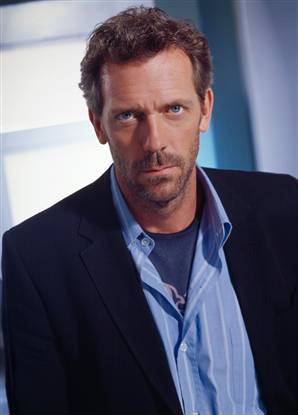
Apparently Hugh Laurie, more famous here in the UK for his role as an upper-class twit in Blackadder, has received a Golden Globe in the US for his role in 'House', described as 'perilously close to perfection'. In spite of these successes, Mr Laurie is still not happy and has suffered from clinical depression in the past.

His insecurities stemmed, it would seem, from a mother who continually criticised him, having set goals for him that he could never attain. With typical British understatement, he has described her as "contemptuous of the goal of happiness".

source

This got me thinking. It seems that contempt for the goal of happiness is quite common, yet I came to the conclusion long ago that it is such emotions that ultimately drive us - not abstract ideas or principles - and that if a person displays contempt for happiness it's just that they have a more convoluted pursuit of happiness than most. What they really have contempt for is other people's ideas of happiness or what they see as lack of ambition. But they are still in pursuit of their own happiness which happens to be deferred until certain goals are achieved.

A great many celebrities and other highly ambitious people suffer from the same sorts of problems as Hugh Laurie. Their ambition is a carrot and a stick which goads them to further achievement in pursuit of fleeting pleasures - happiness which is often based on flattery from the recognition of a fickle public. Some of the happiest people I've met actually have a rather modest life.

The evolution of our genes and our economies and cultures aren't 'interested in' our happiness except in so far as it acts as a carrot on a stick to get us to do other things such as reproducing and doing productive work.

Genuine happiness (as opposed to carrots and sticks) is something we have to sometimes step back from the genetic and economic treadmills to find for ourselves. It wasn't until a few years ago that I really started to take the business of finding out how to be happy seriously. Until then, like most people, I had a sophisticated contempt for it. What mattered was my values, self-expression, intellectual understanding, short term sensory gratification, experience for its own sake, having an interesting life, creativity.

A few years ago I realised that while I wasn't exactly miserable I wasn't really very happy either and took conscious steps to do something about it.

Now, I'm not saying that my life is perfect or even that I'm unusually happy, but I'm significantly happier than I was. It's difficult to know how much is down to having a great relationship with Emily, how much is down to being the father of a great little boy, how much is down to practicing Zen and how much is down to just growing up. But what I do know is that its important to not to choose a partner for egotistical reasons - because it's flattering in some way - do it for love and companionship. Know the difference between infatuation and love and between lust and love.

I also know it's important to appreciate the present and not defer your happiness to some imaginary time in the future. I don't mean that we should live entirely for the present - we can pursue goals for the future while living in the present and enjoying it and realising that if we put all our hopes on what lies over rainbows we'll be running after them forever.

There is nothing wrong with goals - we need to make provision for the future and we can enjoy doing it, but if we make ourselves slaves to goals they will make us unhappy. What goals to set ourselves is a personal and sometimes an ethical decision. But we need to look after ourselves and to do that we need to know what is really in our interests - we need to evaluate which goals are good for us and which ones are just dreams to make us run around on our little wheels all the faster.

Monday, January 23, 2006

Snow in Monument Valley

Speaking to Jules on his blog I was reminded of the time I spent in Arizona and especially a blizzard at Monument Valley, the aftermath of which was incredible to behold. My awe was so great that, leaving my hire car in neutral I got out to take another photo and almost lost it over the edge of a small cliff. Here's a selection of photos:

photos by Justin